A new program unites West Coast readers for stories of Japanese American incarceration
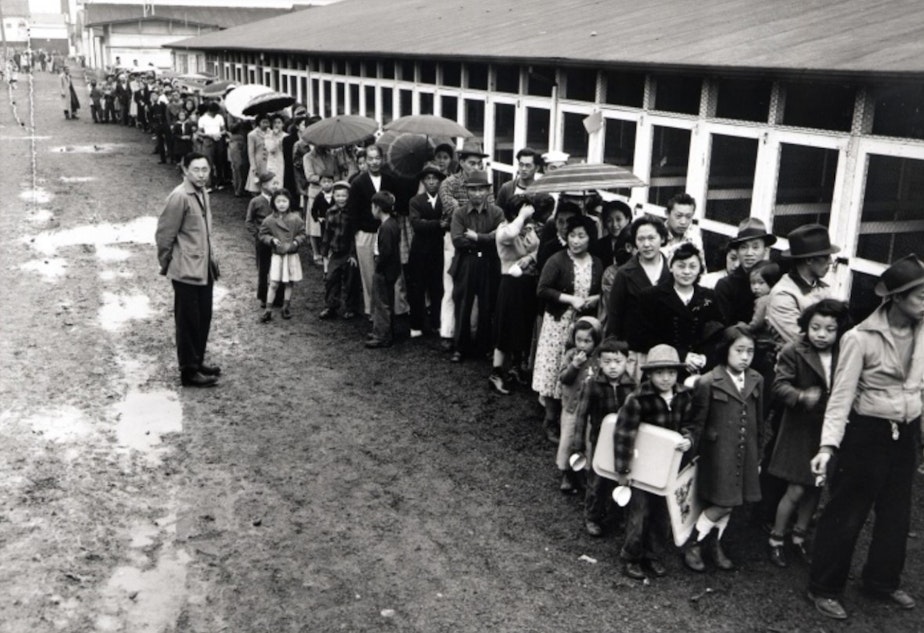

A new program dubbed “the largest book club on the West Coast” is uniting libraries to explore an often erased chapter of the region.
For the first time ever, patrons of over 140 different library systems across Washington, Oregon, and California are joining in for the “One Book, One Coast” program. The club’s first pick, actor and activist George Takei’s graphic memoir “They Called Us Enemy,” follows Takei’s childhood years imprisoned in incarceration camps in Arkansas and California during World War II.
Like more than 110,000 people of Japanese ancestry living on the West Coast, Takei’s family were evicted from their home and placed in incarceration camps during the war without due process, after President Franklin Roosevelt's issued Executive Order 9066.

Between now and May, library patrons of participating systems, like Seattle Public Library, will have access to unlimited digital copies of “They Called Us Enemy” in both English and Spanish. Readers can check out copies through their online library account.
Sponsored
The program is also giving local Japanese American authors a chance to share their own stories about the legacy of the incarceration camps and the history of anti-Asian violence in America.
Writer and historian Frank Abe will discuss an anthology he co-edited for Penguin Classics, “The Literature of Japanese American Incarceration,” at the Central Library branch on April 8. The collection features nearly 70 pieces of fiction, poetry, essays, memoirs, and letters from incarcerees, their children, and descendants.
“When we see what people have lived through before, how they experienced it and how they pushed back against it, we can learn from that experience and understand what’s happening today and how we can act today,” Abe said.
Together with writer Frank Chin, Abe helped launch the first “Day of Remembrance” for Japanese American redress in 1978. Today, Abe says efforts to end birthright citizenship from the Trump administration and the Department of Homeland Security’s expansion of migrant detention centers represent a “repeat” of history.
Sponsored
“I’m glad that we can unite as one coast to help readers see that we can’t stand by while, all around us, the nation is once again targeting people based on their differences,” Abe said.
RELATED: 'History is being repeated.' Japanese Americans call for Northwest Detention Center's end

Tacoma-based writer Tamiko Nimura will also discuss her new memoir, “A Place for What We Lose: A Daughter’s Return to Tule Lake,” during a program event in May.
As a child, Nimura’s father handed her a typed manuscript. The pages contained an early draft of his incarceration experience at Camp Tulelake in California.
Sponsored
“It was a book for grown-ups, really,” Nimura said. “It wasn’t a book for kids, so I don’t necessarily remember talking to him about it. I might’ve said I liked it.”
Nimura’s father died shortly after sharing his manuscript with his daughter. Years later, as an adult, Nimura went on a community pilgrimage back to the camp. Towards the end of the experience, Nimura broke down in an “ugly cry.”
“I was feeling the loss of my dad finally, after so many years of really trying to not feel that loss,” Nimura said. “And feeling the collective loss and resilience of my Japanese American community.”
The coinciding loss of a father, and unresolved reckoning of her family’s incarceration pushed Nimura to “start working backwards” to research and fill the gaps within her father’s story. Set to release April 28, the memoir interweaves the manuscript Nimura’s dad shared with her decades ago, and her present-day journey as a writer.
Sponsored
It’s taken 15 years for Nimura to write and publish her memoir and she feels "devastated" that the book is "so relevant to today’s news."

"I am also quietly and respectfully joyful that I get to bring this book into the world when so many descendants are coming to terms with what it means to reckon with this history,” she said.
RELATED: Asian American history isn't required in WA schools. A new group wants to change that
Now, Nimura says she feels more connected to descendants who are digging deep into their own genealogies to ask themselves complicated questions.
Sponsored
“What are the forces that have gone into the making or silencing or erasing this kind of history?” Nimura said. “Especially when it’s affected our coast so powerfully?”
Nimura hopes that readers who pick up Takei's memoir — especially those who have never gotten the chance to learn about the incarceration of Japanese Americans — probe those questions, too.
-
Noel Gasca

General Assignment Reporter
Noel is a general assignment reporter for KUOW, covering everything from city hall to pickleball. Prior to joining the newsroom, Noel worked as a producer for KUOW’s midday show Soundside. Noel has also worked as an online editor and producer with KUOW’s web team, and she’s also a proud graduate of KUOW’s RadioActive program.
More stories from Noel Gasca »


