An earthquake could break Seattle into several 'islands'
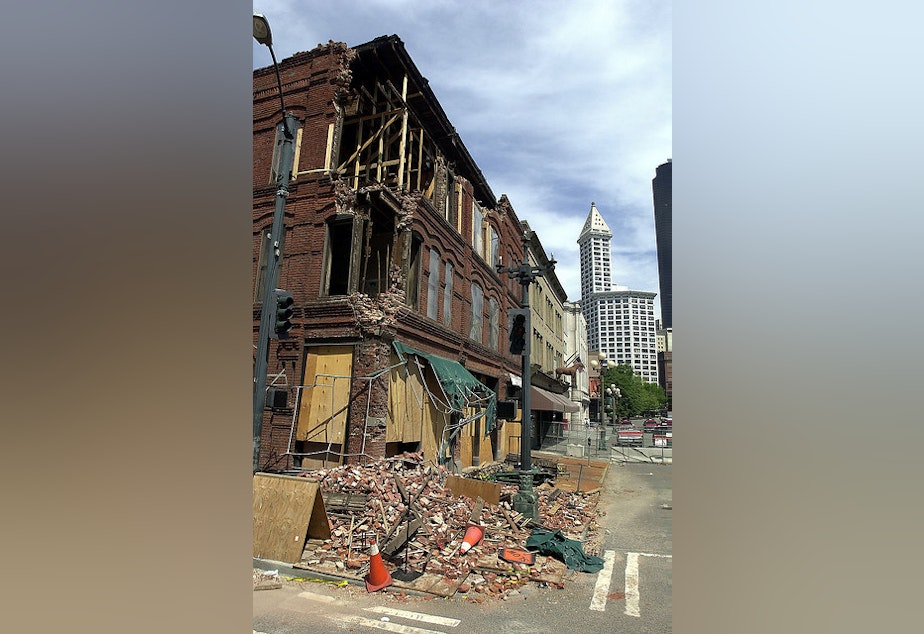

Given its geography, Seattle faces some unique challenges were it to face something similar to the magnitude 8.8 earthquake that struck early Wednesday off Russia's coast, causing fears of tsunamis across the Pacific and up and down the West Coast.
Such an event could break Seattle into several islands — not islands surrounded by water, but islands nonetheless.
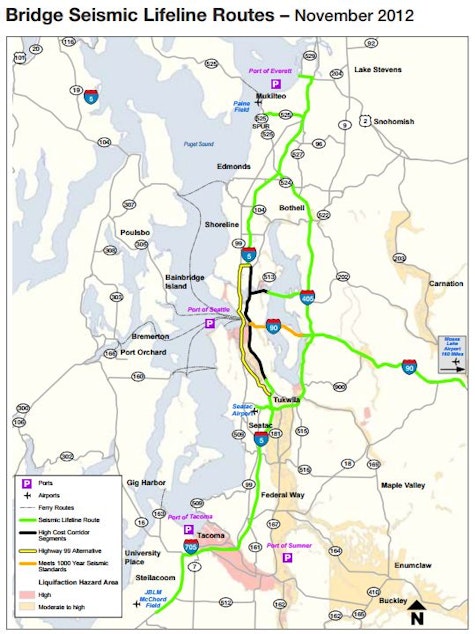
Curry Mayer, director of Seattle's Office of Emergency Management, said one of the key issues facing Seattle in the event of a major quake is that, to get around the city, you have to cross a lot of bridges.
“ The damage to the roadways and also to the bridges will cause there to be isolated areas which we're calling 'islands,'" Mayer said. "They won't actually be islands obviously. There'll be areas that are isolated from being able to get from one place to another.”
Take, for example, the main roads in and out of Ballard. They cross under Aurora via underpasses, which could collapse.
Or West Seattle, which is practically an island already.
“So you may be able to do a lot of movement on foot, but not necessarily in cars,” Mayer said.
Sponsored
RELATED: Hundreds of small earthquakes are hitting Mount Rainier. Geologists say they're not concerned
Her office has been working on decentralized community hubs: Places strong enough to resist a quake where people could gather for information, supplies, and emergency services.
Not every hub will have the same supplies. One could have a clear path to a working hospital, for example. It all depends on the extent of the damage.
Each hub would have special communications infrastructure, so that different "islands" could work together to shift supplies where needed.
Sponsored
RELATED: A decade after 'The Really Big One,' this author imagines the devastation of the major quake
And the technology making that communication work — old-time ham radio operators. Picture a hobbyist in a shack, working old, carefully restored equipment, picking up signals from all over the world.
"Yep," Mayer said. "Some people's cellphones now will also connect to satellite. But the amateur ham radios are the most reliable during disasters, so we rely on them a lot."
One obstacle: Seattle has less money for disasters going forward, due to federal budget cuts.
RELATED: The Trump administration says it wants to eliminate FEMA. Here's what we know
Sponsored
Correction, 8/6/25, 3 p.m. OEM Director Curry Mayer clarified that the number of 'islands' can't be known before an earthquake — it depends on exactly where damage occurs. A previous version of this story mentioned a specific number of seven islands.
Sponsored
-
Joshua McNichols

Reporter
As KUOW's Growth and Development reporter and co-host of KUOW's Booming podcast, Joshua's "growing pains" beat sits at the nexus of housing, transportation, urban planning, government and the economy. His favorite stories also include themes of history, technology, and climate change.
More stories from Joshua McNichols »


