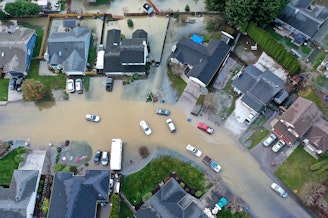
Emergency repairs sought for damaged Stanwood levee north of Seattle
City and tribal officials are seeking emergency permission to fix a crumbling levee near the coastal city of Stanwood, Washington, before disaster strikes.
The century-old earthen structure protects the city and 1,800 acres of nearby farmland from the waters of Skagit Bay.
Waves and wind gouged the outer side of a half-mile stretch of the aging structure during a king tide—one of the year’s highest tides—in January.
If the levee were to fail, floodwaters could displace 1,100 people in the Stanwood area and damage buildings worth $480 million, according to a 2022 Snohomish County study.
Stanwood City Hall, a police station, three schools, and three nursing homes could flood with sea water.
RELATED: Trump administration denies mitigation aid after WA floods
Sponsored
Stanwood-area farmer Tyler Breum knows the levee as well as anyone. He farms potatoes and grass, beet, and spinach seeds just behind it.


“ Everything behind us is underwater if something happens to this levee that you're standing on,” Breum said to a pair of visiting journalists perched atop the shrub-covered, three-mile-long levee. “As you can see, this is the narrowest part. It's a couple feet wide on top, to be generous.”
Some levees are robust enough to drive a truck on top of.
Breum has been pushing for the Stanwood levee to be improved since 2010. Much of it is eroding and vulnerable to leaks, overtopping, or outright failure.
Sponsored
“This was built back in the 1920s and to our knowledge, it wasn't built to any standard,” Breum said. “And it was built by using material just found here on site.”

In early January, a group of duck hunters noticed a king tide overtopping the levee for several hours as waves hit from the west on a windy day.
When the tide retreated, it revealed a half-mile stretch of the levee had been badly eroded, with driftwood piled atop it, its normal 45-degree-slope replaced by a vertical, even overhanging face, and its protective layer of boulders lying uselessly beside it.
“You have kind of a shelf of levee that's unsupported because the underneath of it has been eaten away,” Stanwood city engineer Alan Lytton said after inspecting the site in April.
Sponsored
RELATED: December's record flooding caused $182M in WA infrastructure damage, Ferguson says
“Once you get overtopping, the levee eats away quickly,” Lytton said.
He and other officials say the levee might not survive another winter and the king tides that come with it.
“Unfortunately, the levee is in such poor condition after that king tide that we don't think we'll be able to wait for a year, two year, three year, however long these permits are going to take to have in hand,” Lytton said.
“If we don’t do anything in the next year or two, that levee will fail, and the area will flood,” said Jason Griffith, the Stillaguamish Tribe’s environmental manager.
Sponsored

Like many levees, the Stanwood structure separates farmland from tideland.
Tidal marshes are critical nurseries for Chinook salmon, protected under the Endangered Species Act and the primary food source for endangered Southern Resident killer whales.
In 2024, the National Oceanic and Atmospheric Administration barred Skagit County’s Dike, Drainage, and Irrigation Improvement District No. 12 from replacing a tidegate on No Name Slough unless they restored as much salmon habitat as the tidegate would harm over the next 50 years.
“To recover endangered Chinook salmon in Puget Sound (and by extension, Southern Resident killer whales), we must stop the loss of nearshore habitat and improve blocked access to their estuarine rearing habitat,” an agency webpage explaining the No Name Slough decision states.
Sponsored
The agency’s new approach brought more aggressive requirements for boosting Chinook salmon habitat in the Skagit delta and beyond.
Projects like Stanwood’s stalled as they had to be redesigned to do more for salmon.
“We had the rug pulled out and everything changed,” said Jason Griffith, the Stillaguamish Tribe’s environmental manager.
The Stillaguamish Tribe has been collaborating with the city to try to fix the muddy berm that makes the city of Stanwood possible.
“We've been scrambling,” Griffith said.
Griffith said the Stillaguamish Tribe had been aiming to restore 12 acres of salt marsh to offset the three acres that would be damaged in beefing up the Stanwood levee. After the No Name Slough decision, the tribe has had to aim to restore 62 acres to get federal approval for the project, Griffith said.
“It's not very simple to just go out and find a place to create 50 acres of tidal wetlands,” Griffith said.
Puget Sound tribes, including the Stillaguamish, are known less for building or upgrading levees than for trying to remove them to help salmon and orcas.
“As long as it takes, we'll be working to get the fish back where they need to be,” Stillaguamish deputy fisheries manager Scott Boyd said. “The more Chinook there are, the healthier our southern killer whales will be. So, it's just part of a wider chain.”
RELATED: The Stillaguamish Tribe gives its river north of Seattle room to roam
But Griffith says for this project, the Stillaguamish Tribe is willing to pursue immediate construction, without helping salmon.
The tribe is mostly trying to be a good neighbor.
“A lot of the tribal members are residents in this area and shop in the businesses in Stanwood and that sort of thing,” Griffith said. “We're trying to work with the community on their priorities while still advancing salmon habitat restoration where we can.”
He said he feels personally responsible to get construction going and not let a flood devastate Stanwood.
“I would be lying if I said it didn't keep me up some nights,” Griffith said.
The city and the tribe hope to get permission from the Army Corp of Engineers for emergency repairs this summer. That will depend on Snohomish County Drainage and Diking Improvement District 7, which maintains the levee, and the city of Stanwood declaring emergencies.
If the Army concludes that immediate construction would prevent an unacceptable hazard to life, a significant loss of property, or an immediate and significant economic hardship, it can provide emergency authorization, which can take “from a few hours to up to a week.”
Non-emergency authorization, from the Army Corps and from the National Oceanic and Atmospheric Administration, could take two or three more years, according to Griffith.
NOAA spokesperson Michael Milstein did not directly respond to a question about how long it takes to issue a construction permit near Chinook salmon habitat. In an email, he said the project proponents could avoid the usual endangered-species consultation process if the Army Corps grants emergency status.
Since the Stanwood levee was built a century ago, sea level has risen around Puget Sound an average of six inches. That’s enough to boost the frequency of levee-topping floods, according to oceanographer Ian Miller with Washington Sea Grant at the University of Washington.
“As sea level rises, you enhance the opportunities the ocean will have to batter these things, and maintenance becomes really important,” Miller said.
He said mid-range forecasts predict about four times as much sea level rise over the next 75 years as the region experienced over the past century.
“You raise sea level another two feet and the number of times that [flooding] occurs and the likelihood that it occurs increase quite a bit,” Miller said.
-
John Ryan

Environment Reporter
John Ryan joined KUOW as its first full-time investigative reporter in 2009 and became its environment reporter in 2018. He focuses on climate change, energy, and the ecosystems of the Puget Sound region.
More stories from John Ryan »