Police pause license plate readers to comply with new Washington state restrictions
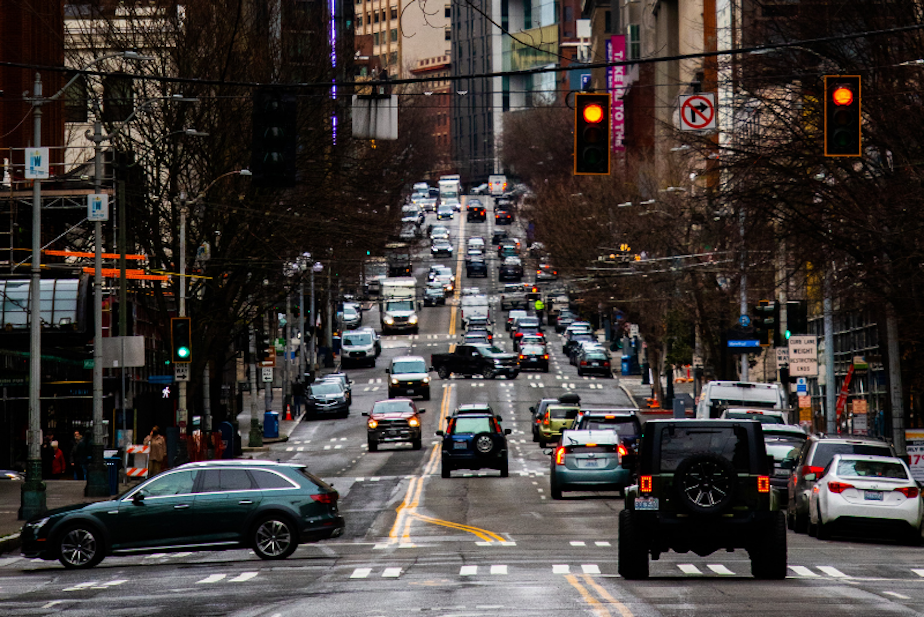

Law enforcement agencies, including Seattle and Kent, that use automated license plate recognition in their patrol vehicles have temporarily turned those systems off, while they seek solutions to comply with a new state law.
That new state law took effect March 30. SB 6002 sets a 21-day retention period for the license plate data, and prohibits gathering it at, and around, a number of sensitive locations. Those locations include places related to immigration matters, reproductive healthcare, schools, places of worship, courts, and food banks. According to the ACLU of Washington, that location-based restriction is unique across the country.
RELATED: Washington adds safeguards for Flock cameras
“We suspended our mobile license plate readers because we could not ensure that they wouldn’t incidentally capture license plates in those restricted, protected areas,” said Kent Police Chief Raphael Padilla.
Chief Padilla said Kent has fixed-location cameras made by Flock, which remain in use after the city verified that none of them capture license plates near prohibited locations. But the mobile readers made by Axon for police vehicles present special challenges since they gather the data while moving throughout the city.

“I’ve been in conversations with heads of both the two major vendors, the CEO’s, and they are committed to finding a solution whether it be geofencing locations or setting up other protected parameters," Padilla said.
Seattle is seeking the same answers, according to City Councilmember Bob Kettle, who chairs the public safety committee.
“First thing is working with Axon to ascertain what is the art of the possible, from a technology point of view,” he said.
Kettle said temporarily disabling the readers makes sense, but will hinder police work in the meantime.
“That will have an impact, no doubt in terms of this period of time where we’re trying to be in sync with state law,” he said.
Sponsored
The Axon license plate reader isn't an actual camera, rather, it's software that feeds off of a patrol car's dashboard camera. As a patrol car moves through the city, it monitors the dash cam's video feed, reads license plates, and automatically flags plates related to stolen vehicles, missing persons, and criminal suspects. The Axon software can be turned off, while the dash cam continues running.
The Seattle Police Department said in a statement that Chief Shon Barnes issued a directive March 20, after Mayor Katie Wilson’s broader announcement on next steps regarding surveillance technology, to suspend all use of automated license plate recognition, including for parking enforcement.
“The department currently has no set date for the reintroduction of this tech into patrol cars or parking enforcement vehicles,” SPD said in a statement. “These changes will likely have financial and operational impacts on the department.”
In an email, Sgt. Patrick Michaud added that, “We now have gone back to the old way of typing in plates and reading back the results. Same results, just much slower.”
RELATED: Is Mayor Wilson turning off police cameras? Sort of
Sponsored
An Axon spokesperson said told KUOW that agencies are responsible for configuring their systems, but the company is working closely with them.
“Axon is committed to ensuring our technology aligns with all applicable state and federal requirements, including Washington State law SB 6002," the spokesperson said. “Axon is supporting our customers as they evaluate Washington’s SB 6002 and align their systems, policies, and workflows with the new requirements.”
Padilla is the incoming president of the Washington State Association of Sheriffs and Police Chiefs. He said establishing a consistent configuration for the systems statewide will help with the audits required by the new law, and WASPC’s technology committee can help set that framework. Agencies that use the technology are required to register with the state attorney general’s office, which will issue annual reports on the use of the systems.
Beyond the technology questions, Padilla said Washington’s overall effort to regulate license plate readers is “a good thing,” especially the new protections from public disclosure of the data which he said helps protect victims of crime.
“There was a real vulnerability there particularly with domestic violence victims,” he said.
Sponsored
But he said the new requirement that data not be retained beyond 21 days could put some investigations in jeopardy. Padilla said sometimes people only detect a property crime after several days have passed and then the case gets passed to a detective.
“That detective, unlike [what is seen] on TV probably has two or three dozen cases they’re working on,” he said. “You eat up multiple weeks sometimes before a detective or investigator realizes, ‘Hey, there’s a suspect vehicle and they may have passed by one of our ALPRs, let’s go check for leads.’”
RELATED: Gov. Ferguson signs controversial law tightening standards for Washington sheriffs
In Seattle, Councilmember Kettle said the city's Real Time Crime Center can help gather evidence within the 21-day deadline.
The ACLU of Washington called the law, known as the Driver Privacy Act, an important first step in regulating what it called a growing surveillance network across the state. But the organization expressed disappointment that lawmakers broadened the retention and use of license plate data from the original proposal.
Sponsored
The new law “does not fully meet the moment,” the ACLU said in a statement. “Most notably, the bill signed by Gov. Ferguson allows agencies to retain ALPR data for 21 days, which is only marginally less than the current status quo of 30 days. It also allows local jurisdictions to share ALPR data with each other and expands the use of ALPRs beyond felony investigations to include gross misdemeanors. Taken together, the law falls short of preventing the harms it was intended to address.”
The law itself said it’s intended to establish “guardrails on the use of surveillance data collected from monitoring the location and travel of individuals, without a warrant, to ensure its use by law enforcement and other government agencies must not come into conflict with existing protections for Washingtonians and ensure that it is not being used for purposes prohibited under state and federal law.”
This week the Seattle City Council also passed an ordinance co-sponsored by Councilmembers Kettle and Alexis Mercedes Rinck to prospectively turn off the ALPRs for 60 days if the city receives a warrant, subpoena or other indication that the data is being used for civil immigration enforcement or reproductive healthcare enforcement purposes.
-
Amy Radil

Reporter
Amy Radil is a reporter at KUOW covering politics, government and law enforcement, along with the occasional arts story.
More stories from Amy Radil »


