Seattle tables safety plan for Lake Washington Boulevard after Mayor's Office weighs in


After two years of public process to discuss potential improvements to Lake Washington Boulevard, the city has tabled the second half of the safety measures it had planned to install on the street this year.
That’s after Mayor Bruce Harrell’s office weighed in on the $400,000 safety plan, which included money the City Council earmarked for the street, as well as a grant from the Washington State Transportation Improvement Board.
Lake Washington Boulevard is a windy road with no shoulder, shared by cars, bikes, and pedestrians crossing to and from the waterside path.
RELATED: Why the future of Seattle's Lake Washington Boulevard has sparked a heated debate
The median driver goes 10 miles per hour over the road’s speed limit, and Seattle’s transportation department says the street, which saw about 100 crashes between 2015 and 2022, has a “very high collision rate.”
Sponsored
The city had previously planned to add 24 speed cushions and to redesign an intersection to reduce conflicts between drivers. The first 12 speed cushions went in about a year ago, and the rest of the work was slated for 2025.
But this summer, the city backed away from that plan, indefinitely tabling the remaining speed cushions and the changes to the dangerous intersection. Since then, at least one cyclist has been hit by a car while biking on the section of the road where the city was supposed to install speed cushions this year.
RELATED: Despite safety measures, promises, and plans, more people are dying on Washington roadways
The Mayor’s Office’s first known involvement with the Lake Washington Boulevard project was a meeting in mid-2024, when it met with a group opposing the planned speed cushions.
A group that supported the city’s safety plan told KUOW that its members asked the Mayor’s Office for a meeting to present their side of the issue, but that was declined.
Sponsored
A spokesperson for Harrell confirmed that his office was involved in the decision to table the second half of the project, “balancing safety measures with the diverse feedback we heard from the community.” The spokesperson pointed to a public meeting that was held in December 2024 and noted that participants expressed “both strong support and opposition for additional traffic calming measures.”
Harrell lives steps from Lake Washington Boulevard, but a spokesperson said in an email that Harrell’s office regularly provides input on street design, not just in the mayor’s neighborhood, and added, “Mayor Harrell was not personally involved in the decision” to indefinitely suspend the planned safety measures.
The spokesperson did not respond to a follow-up email asking if there was another instance when the Mayor’s Office weighed in about a traffic-calming project that was already planned and funded, and that project was then suspended.
Since then, at least one person has been struck from behind while biking on the section of the street where more speed cushions were supposed to be installed. Bradley Hawkins, who was hit in mid-August when he was returning from a bike camping trip, said the street has become even more dangerous since the city added fog lines that give drivers the false impression that there’s a bike lane along the road.
“Cars were going way faster than they usually do,” he said. Right before Hawkins was hit, he said, “I realized that [the driver] was not changing lanes” to pass him.
Sponsored
Hawkins was thrown from his bike; the bike was destroyed; and the car lost a front light, rearview mirror, right front bumper, and fender cowling. The driver did not stop, and the police report labels the incident a hit-and-run. Hawkins spent the night in the Harborview emergency room.
“That’s the worst-case scenario, frankly: stopping the traffic calming,” said Terry Holme, who’s lived in Seattle’s Mount Baker neighborhood for decades and was on the task force that discussed options for the street. “The principal recommendation of the task force was to do traffic calming, so the fact that they reneged on what was a consensus was very disappointing.”
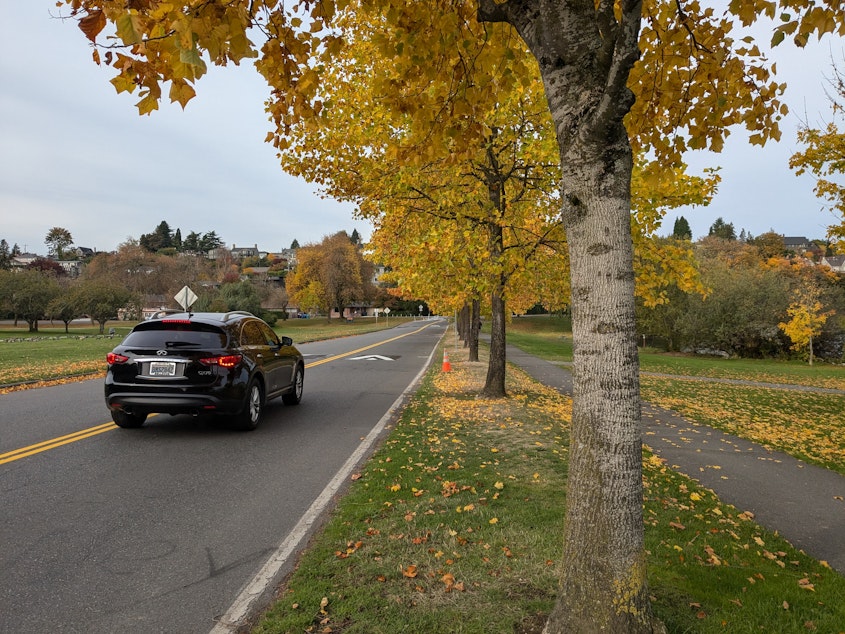
Shortly after the first speed bumps were installed last fall, neighbor Erin Duff walked with her baby and dogs along the street.
“I’m glad that we’re making these changes,” she said. “I wish we could do a little bit more and have it be more pedestrian-friendly and just safer. It’s definitely a little scary to cross with the baby and the dogs every day.”
Sponsored
Duff said she also drives on the street.
“I try to be really careful to drive 25 when I'm on it, and I notice I get a huge pile-up of cars every time I do that,” she said. “People get a little aggressive and unsafe — so I think these measures are great.”
Duff’s opinions are in line with what the city found in two years of public outreach and surveys: Most people support safety measures on the street.
And in most Seattle neighborhoods, speed cushions go in without much comment. Speed cushions are low-rise — shorter than speed bumps — with cutouts so emergency vehicles can use the street without slowing down. Seattle installed them on nine arterials throughout the city in 2024, and has more planned for 2025 and 2026 as part of Vision Zero, the city’s goal of ending traffic deaths and serious injuries.
But on Lake Washington Boulevard, a group of neighbors organized against the speed cushions.
Sponsored
“The addition of multiple speed bumps has created a new safety hazard, because cyclists swerve to avoid them, and cars swerve to avoid them,” said Shelley Morrison, a member of the opposition group.
Traffic experts disagree with her about speed bumps: Multiple studies show they make streets safer by slowing down cars.
Morrison’s group is also concerned that the speed cushions cause discomfort, risk vehicle damage, and could encourage drivers to choose other streets, increasing congestion there.
The city says it plans to gather data and could return to the idea of speed cushions in an as-yet unscheduled third phase of increasing safety on Lake Washington Boulevard.
“We remain committed to open dialogue and ensuring future decisions reflect the needs of all stakeholders,” a spokesperson for the Parks Department said in an email.
-
Eilís O'Neill

Reporter
Eilís is a reporter covering health. She focuses on health inequities, substance use and addiction, infectious diseases, mental health, and reproductive and maternal health.
More stories from Eilís O'Neill »


