Sidelining Trump appointee, federal judges in Seattle will name new US attorney
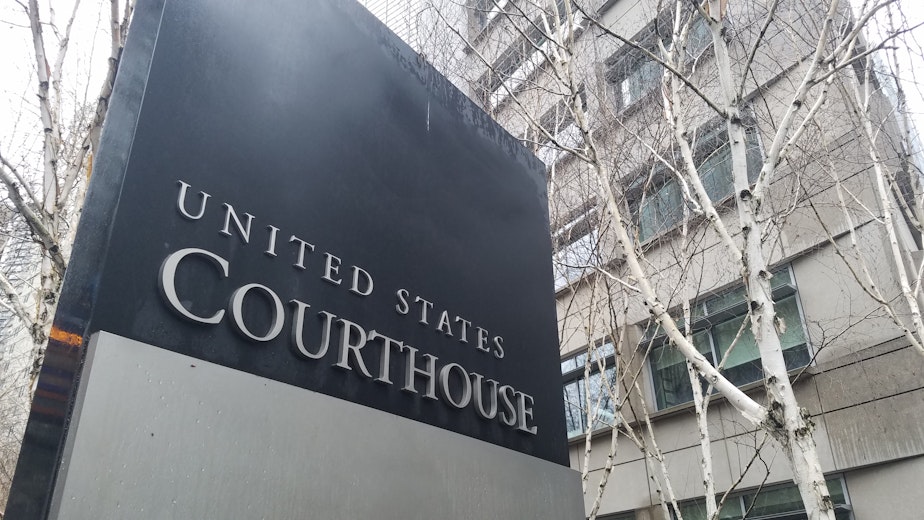

The chief federal judge in the Western District of Washington announced today that the court intends to exercise its power to appoint a new U.S. Attorney in Seattle. The Justice Department's appointee — interim U.S. Attorney Charles Neil Floyd — cannot continue to serve beyond Feb. 3 without support from either the U.S Senate or federal judges in Western Washington.
It's one of several jurisdictions where top federal prosecutors appointed by Attorney General Pam Bondi have failed to retain their positions, which requires either presidential nomination and Senate confirmation, or reappointment by the federal courts. The district court's appointee is allowed to serve until the position is filled by the president and goes through the confirmation process.
The federal court in Delaware took a similar approach last fall when Trump’s pick failed to win Senate confirmation and stepped down. After some pushback from Deputy Attorney General Todd Blanche, the court took applications and chose an existing prosecutor for the top job.
The federal court in Seattle has also used this option to appoint longtime federal prosecutors when vacancies occurred. Under the federal law governing these vacancies, after 120 days an interim U.S. Attorney must be nominated by the president and confirmed by the U.S. Senate or reappointed by the district court. Floyd was sworn in on Oct. 6, 2025.
The court’s order signals an unwillingness to retain Floyd as the region’s top federal prosecutor. Instead, Chief District Judge David Estudillo outlines a process for all interested candidates to apply for the position over the next two months.
In districts where federal judges have not exercised their authority after the 120 days, other Trump administration appointees have been forced to resign, like Alina Habba in New Jersey, or remained in their position thanks to a workaround, as in the case of Pete Serrano in the Eastern District of Washington.
Sponsored
(Meanwhile the Justice Department and federal courts are actively contesting whether Lindsey Halligan remains the interim U.S. attorney for the Eastern District of Virginia, according to Politico.)
Sen. Patty Murray, a Washington Democrat, opposed Pete Serrano’s U.S. Senate confirmation, saying his “extreme right-wing views are far out of step with the people of Washington state,” according to the Washington State Standard. A longstanding Senate tradition allows senators to block the advancement of nominees for U.S. attorney positions and federal judgeships in their states by denying them so-called “blue slip” endorsements.
Federal judges in the Eastern District of Washington also declined to intervene or to reappoint Serrano. At that point U.S. Attorney General Pam Bondi gave Serrano two job titles that allow him to continue leading the office. He is a “special attorney” to Bondi and the First Assistant U.S. Attorney in the district.
In contrast, the federal court in Delaware did intervene when the Trump administration’s appointed U.S. attorney failed to receive Senate confirmation. The state’s chief federal judge, Colm Connolly, who was himself appointed by President Trump, publicly sought applications and ultimately appointed an internal candidate, Benjamin Wallace, to the top post. Deputy Attorney General Todd Blanche rebuked the judge’s decision on social media but ultimately Connolly’s order prevailed.
The judges in the Western District of Washington have also used their authority to appoint a U.S. attorney recently. In May 2024 they issued an order to retain Tessa Gorman as U.S. Attorney after Biden’s Senate-confirmed candidate Nick Brown left the office to run successfully for state attorney general.
Sponsored
But in this case the order makes clear the court is looking for additional applicants rather than simply reappointing Floyd.
According to his biography, U.S. Attorney Floyd has expertise in the legal framework around immigration enforcement. Floyd served as a federal prosecutor in the District of Columbia, an assistant chief counsel at U.S. Immigration and Customs Enforcement, and as an immigration judge in Tacoma.
In that capacity, Floyd and some of his colleagues used what the Seattle Times called a novel legal argument to deny bond requests for longtime residents accused of illegally entering the U.S. A district court judge found the denials unlawful in a class-action lawsuit filed by the Northwest Immigrant Rights Project. In an interview with the Seattle Times last October, Floyd defended the denials, saying immigration judges are bound by the policies of the Trump administration’s Board of Immigration Appeals, rather than the ruling of the federal court.
This is a developing story and will be updated.
Update 1/14/25 2pm: Brian Moran served as U.S. attorney in Seattle under the first Trump administration and is now an attorney in private practice. He said the court’s announcement that it will consider applicants to serve as U.S. attorney doesn’t necessarily mean Floyd won't be retained. Floyd could apply, and Moran said it’s natural for the court to seek an open, transparent process at this point. Moran said, “The clock’s run out, and the court’s just signaling that they’re going to take that role seriously and they’ll look at all candidates.”
He added, “I think what’s really going on here is the judges want to signal – appropriately so of course – that they have an independent function as a separate entity."
The U.S. attorney's office hasn't yet responded to a request for comment.
Sen. Murray offered this statement: “Charles Neil Floyd has a track record of denying bond for immigrants who pose no threat to our communities—I was not consulted on his temporary appointment as interim U.S. Attorney and, if he were to be nominated for a Senate-confirmed position, I would block his appointment. I will oppose any candidate who does not align with Washington state’s values.”
-
Amy Radil

Reporter
Amy Radil is a reporter at KUOW covering politics, government and law enforcement, along with the occasional arts story.
More stories from Amy Radil »


