'An IOU doesn't pay my mortgage.' Bremerton suffers as shipworkers go unpaid
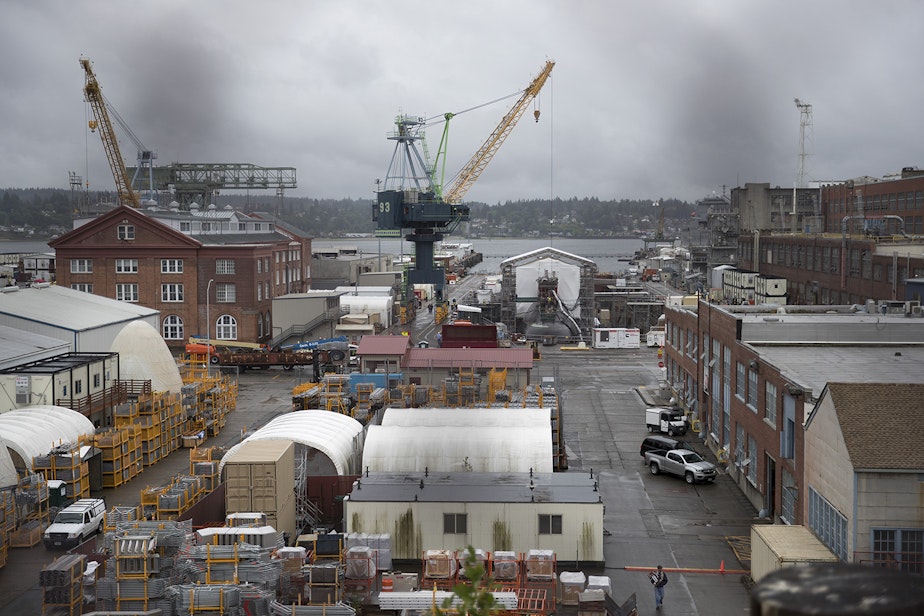

Outside the gates of the Puget Sound Naval Shipyard in Bremerton, workers are heading straight home. Along the street to the ferry, coffee shops are closing up early, and bars are expecting fewer Monday Night Football watchers than normal.
“Across the board, everybody’s feeling it,” said Saleem Patterson, tending an empty bar at the Town Portal arcade across from the shipyard. “Because this is a Navy town, and of course it’s going to be the first place to get hit, right? Like, if you can’t afford to go out and play, you’re not going to go out and play.”
The longest federal government shutdown in history has hit Bremerton like a broadside. One out of every three workers in Kitsap County works for the U.S. government, whether for the Puget Sound Naval Shipyard, Naval Base Kitsap, or the Department of Defense. The U.S. Navy relies on this community’s civilian workers to build, maintain, and repair its vessels, so it’s a matter of national security that they continue to work during the shutdown.
They haven’t been paid in 42 days. While relief may be on the horizon – the Senate voted this week to end the shutdown, and the House is slated to weigh a temporary funding deal on Wednesday – the nearly six-week lapse has shaken the faith of Bremerton’s federal employees.
“Nobody in their right mind would work for a company that behaves like this,” said a graveyard shift worker at Naval Base Kitsap. “The only remaining benefit of being a fed now is knowing that I am still doing my best to serve the people of the U.S.”
Sponsored
KUOW interviewed five federal employees at the shipyard and nearby Naval Base Kitsap who agreed to speak anonymously for fear of reprisal. A dire picture emerged: 50 or 60-hour weeks, 7-day work weeks, workers forced to do overtime, or take temporary duty assignments in other ports with no per diem.
“There’s really no job in the world where they can not pay you and still force you to show up. And guilt you into it,” said J, a technician who works with radioactive materials. “I’m a veteran myself, most of my coworkers are veterans, so they have that same esprit de corps, and that’s why I think these groups can be easily manipulated into doing work without compensation.”
Workers must get extra approvals from higher up the command chain for any kind of leave – even family funerals or sickness, sources told KUOW. One said management told workers explicitly not to take leave.
A spokesperson for Naval Sea Systems Command didn’t directly answer KUOW’s questions about whether that was true.
“We understand the stress and uncertainty that a lapse in appropriation poses for our workforce, and we are committed to ensuring they are supported,” Susan Mainwaring, director in the office of corporate communications at Naval Sea Systems Command, wrote in an email.
Sponsored
“Supervisors are encouraged to offer flexibility to address personal matters as best as possible while continuing to carry out essential work that supports the Navy's readiness and mission,” Mainwaring added.
The financial hit these federal employees are taking has rippled into the broader community. In retail shops across the peninsula, business is slow. The local food bank is busier than ever, and in a pawn shop across the Port Washington Narrows, supervisor Jason Waters says guys are hocking guns, gold, and guitars. One shipyard worker told his daughter Christmas might not come this year.
“The pain is starting to come to the surface,” said Joe Morrison, executive director of Kitsap Economic Development Association. Well over $200 million has simply evaporated from the local economy during the shutdown, according to an estimate by his organization.
‘The morale is not good here’
When shipyard and shipyard-adjacent federal workers sign up for the job, they tend to know sea vessels can require work at any time, and they might have to work swing shifts, graveyards, or a temporary duty assignment in San Diego or Guam. But usually they sign up for the extra money or a quick change of scenery – now, when they get back, there’s only a promise of a paycheck.
Sponsored
“An IOU doesn’t pay my mortgage,” said T, who works repairing boats so the Navy can “put warheads on foreheads, as they say.” T said some of the boilermakers, machinists, painters, and pipe-fitters live paycheck to paycheck.
“Now, that’s all anyone’s talking about. It’s, ‘Dude are you okay?’ ‘It’s starting to get tight. I’m worried,’” T said. “It’s doom if it goes into December.”
During the last federal shutdown in 2019, most civilian workers were paid upfront.
“It was just easier,” said Mark Leighton, president of the Bremerton Metal Trades Council, the labor union for skilled shipyard workers.
As this shutdown stretches on, discontent proliferates on the waterfront. In one building, fliers started appearing last month for a walkout on Halloween.
Sponsored
“We are not protesting the Shipyard,” the flier said, according to a photo shared with KUOW. “We are protesting the value of our labor being $0.00.”
A source told KUOW that shipyard management quashed the walkout before it happened and reassigned the “ringleader.” Mainwaring, the Naval communications director, didn’t answer questions about any walkouts.
“The morale is not good here,” said one environmental safety worker, “but people are afraid to speak out.”
At the apprentice program inside the base, where the next generation of shipbuilders studies, students are being forced to choose between attending classes – which the federal government normally pays them for – and driving Uber, working side jobs, or visiting food banks, said Joan Hanten, president of Olympic College, which offers classes at the shipyard.
“Faculty are just anecdotally reporting, ‘I lost three students this week,’” Hanten said. “We’re hearing it daily.” She hopes that most of those absences can turn into incomplete grades rather than full-on failed classes once the shutdown ends.
Sponsored
The college and shipyard have partnered to send vans of food into the facility so students don’t have to leave to get meals. Anyone else has to head up the hill to the city's food bank.
'I can't believe I'm here'
Bremerton Foodline was open late Monday. The food bank, inside an old Coca-Cola warehouse, has expanded its hours to meet the needs of all the new faces – mostly federal workers -- in the last six weeks. Last month, it served 300 families affected by the shutdown.
“I’ve been here forever, and this is the busiest I've ever seen it,” said Brandie Short Western, operations coordinator, after a long day of running around, overseeing trucks coming in the back door full of onions, apples, pumpkins, and toasted oats, sending some to the market floor where they can be picked up like groceries, rerouting others to regional partner agencies.
Short Western’s husband works at the Navy base and isn’t getting paid – like a lot of people here.
Newcomers walking in the front door meet Sherrill Gross, a career federal analyst who just retired in September and volunteers at the front desk.
“It's so sad,” Gross said, tearing up. “The number of people coming in in uniform, and so many of them saying things like, ‘I can't believe I'm here.’”
This story was fueled by a tip we received as partners with ProPublica through the Local Reporting Network.
-
Scott Greenstone

Politics Reporter, Host of Sound Politics
Scott Greenstone covers PNW politics for KUOW, from Congress to county officials, and how decisions in the other Washington affect life here. He co-hosts Sound Politics with Libby Denkmann.
More stories from Scott Greenstone »


