Seattle Mayor Wilson wants to expand tiny house villages — with volunteers’ help
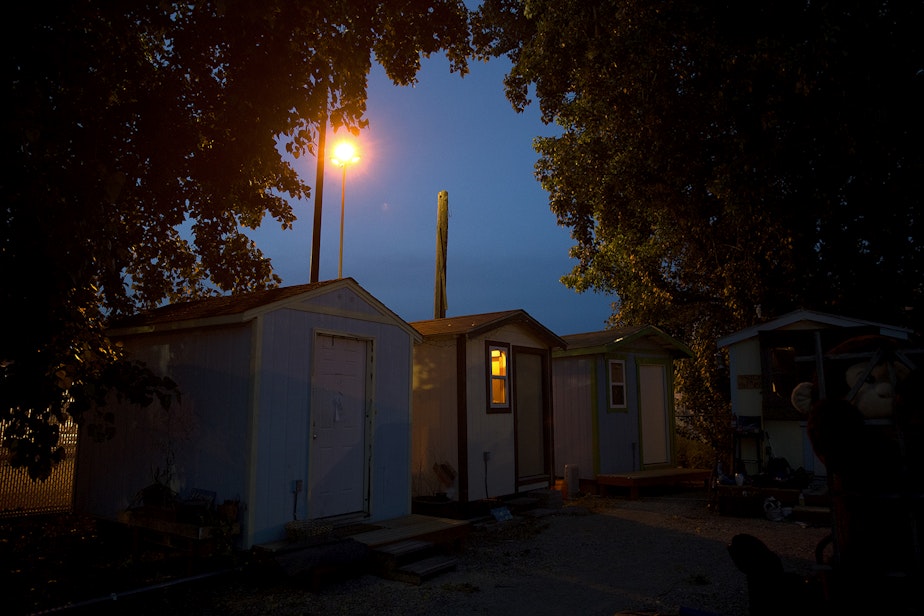

Seattle Mayor Katie Wilson is beginning to sketch out her vision for expanding homeless shelters in Seattle. Though some big details are unclear, her administration is looking to expand tiny house villages and shelters.
She said she has found some spare funding in between “couch cushions” to help pay for the expansion. And, she wants volunteers to help.
On Tuesday, Wilson announced she’d found $5 million in the city budget from housing and human services funds, and will be proposing legislation to remove bureaucratic and regulatory limits on shelters and tiny house villages.
“We are moving faster than ever before, but I want to see the ground start breaking, the hammers start swinging, and fewer people left to sleep in doorways and tents,” Wilson said, standing in the middle of a facility in SoDo where volunteers build tiny houses for shelter villages.
RELATED: Rick Steves steps in to save Seattle-area hygiene center serving homeless residents
To help get to the 1,000 units Wilson has promised, the mayor also called on volunteer Seattleites to join her “Seattle Shelter Acceleration Community Action Team,” which will provide updates and opportunities to volunteer.
Sponsored
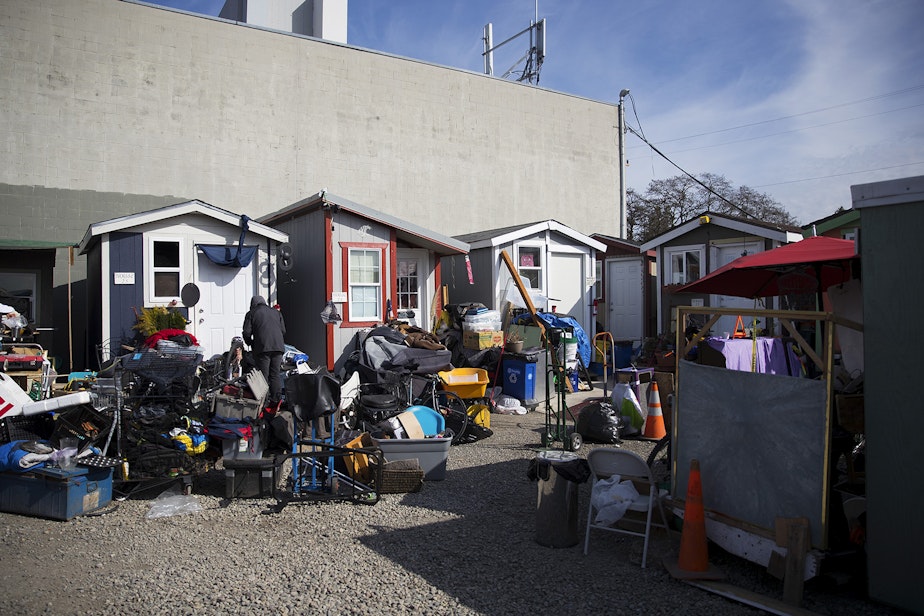
Currently, Seattle’s tiny house villages can only house 100 people per site. Wilson wants the limit raised to 150 per site and “in cases where it makes sense,” 250 at one site in each of the city’s seven council districts.
Seattle City Councilmember Rob Saka, who represents Sodo and West Seattle, also spoke in support of expanding parking lots for people living in RVs or cars.
Which sites Wilson wants to expand aren’t yet clear. The mayor left without answering questions, and members of her team were reticent to name specific villages or facilities that could be expanded.
Leaders of homelessness nonprofits such as Catholic Community Services and Chief Seattle Club spoke in support of the plan.
Sponsored
RELATED: Some Democrats share Trump's goal of forcing more homeless people into medical care
Dan Malone, executive director of the Downtown Emergency Services Center, told KUOW the policy focus makes sense.
“I totally understand why the mayor and others would be emphasizing, ‘We’ve got to do something right now to get people off the street,’” Malone said. “And we definitely have to do that, and we simultaneously have to figure out how we're not going to make this kind of emergency response, be the only response.”
Andrew Constantino, an outreach worker who used to help run tiny house villages and now refers many homeless campers to them, said some have room to grow. But even expanding existing villages from 50 to 75 has been fraught with conflict, he said.

“It can be a pressure cooker,” Constantino said. “If things are too large, the number of people that are going to leave, not by housing, but because of rule violations, are going to grow. It creates more potential for it.”
Wilson’s spokesperson Sage Wilson said the mayor's office found $3.3 million that was in an Office of Housing revolving loan program, and $1.5 million in a “Downtown Health & Human Service fund” from the 1990s that hadn’t been used in a decade.
“The couch cushions had a little bit of money,” said Wilson, who is not related to Mayor Katie Wilson. “Just to be clear, we're not going to be able to shake $4 million out of the corners of the budget every year.”
-
Scott Greenstone

Politics Reporter, Host of Sound Politics
Scott Greenstone covers PNW politics for KUOW, from Congress to county officials, and how decisions in the other Washington affect life here. He co-hosts Sound Politics with Libby Denkmann.
More stories from Scott Greenstone »


